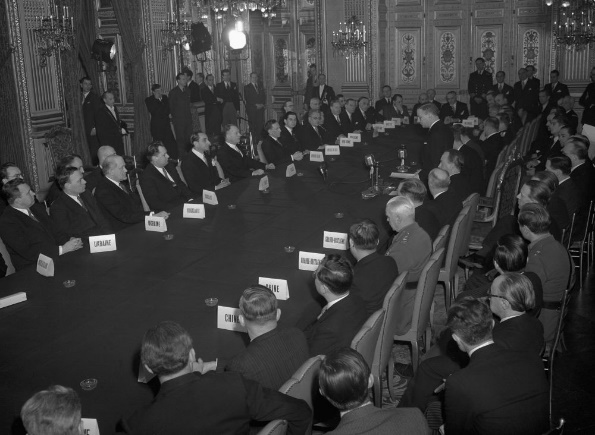
Ma a Magyarok Világszövetségének székházában, Nyers Csaba szerezésében megemlékezés volt a második világháborút lezáró párizsi békéről, amelyet 1947. február 10-én erőszakoltak rá Magyarországra. Az eseményen Patrubány Miklós, az MVSZ elnöke mondott nyitó-beszédet, amely végén felolvasta az MVSZ-nek a párizsi békével kapcsolatos álláspontját. Ma van a párizsi béke 79. évfordulója.
1947. február 10. estéjén Mindszenty József hercegprímás szentségimádásra hívta Budapest népét. Ő maga a Szent István Bazilikában vezette a szentórát. Tízezrek mondták utána – sírva és zokogva – az alábbi imát: „Mindenek Mindenható Teremtője, Alkotója, Ó Nagy Isten! … az ítélkező nemzetek határozatából országunkra, népünkre – épp ebben a kegyetlen pillanatban – az újabb országcsonkítás is elkövetkezett.”
Az MVSZ elnöke által felolvasott nyilatkozat az MVSZ hivatalos petíciójának – Igazságot Európának! – szerves része, annak 3. melléklete.
A párizsi béke 60. évfordulójára
„Mint kígyó sziszegett az egész mezőny” …
Miért volt II. Trianon a párizsi béke?
Az Imrédy Béla magyar miniszterelnök halálos ítéletét kimondó perben a közvádló szerepét betöltő Sulyok Dezső, akit abszolút választási győzelmének birtokában pártja – a Kisgazda Párt – miniszterelnökké jelölt, 1946. február 8-án beszédet mondott a Nemzetgyűlésben. A jobboldali elhajlással nem vádolható politikus követelte, hogy a párizsi béketárgyalásokra utazó magyar küldöttség kérje a trianoni béke néprajzi tévedéseinek helyreigazítását és a magyar határok mentén idegen impériumok alatt egy tömbben élő magyaroknak az általuk lakott területekkel együtt Magyarországhoz való visszacsatolását. Beszédének ez a része viharos erejű, vad ellenkezést váltott ki a kommunistákból. Sulyok így ír erről: „Mint kígyó sziszegett felém az egész mezőny, melyben kommunisták ültek. Elneveztek sovinisztának, háborús izgatónak, revizionistának …” [i]
Ezek után a kisgazda többségű, de mégis kommunisták uralta „magyar” kormányt olyan delegáció képviselte a párizsi béketárgyalásokon, amelynek tagjai – igen kevés kivétellel – nem értették a dolgukat, vagy nem akarták Magyarország érdekeit védeni.[ii]
Fontos iratokat, melyek egészen új megvilágításban tüntették volna fel a magyarság háborús szereplését, a külügyminisztérium egyik szobájából, ahol össze voltak gyűjtve, egy kommunista külügyi tisztviselő utasítására kihordták egy WC-helyiségbe. Ott egymásra szórták, és hónapokon keresztül hagyták pusztulni anélkül, hogy bármit is felhasználtak volna belőlük a magyar nép igazának megvilágítására.[iii]
A békét letárgyalták. Egy csomó magyar marxista az állam pénzén néhány hónapig jól élt Párizsban, és annyit ártottak népünknek, amennyit csak tudtak.[iv]
1947. február 10-én a Szövetséges és Társult Hatalmak elfogadtatták Magyarországgal azt a békét, amely Trianonhoz képest újabb színmagyar területektől fosztotta meg az országot, és a Szovjetunióval szemben 200 millió USD, Csehszlovákiával és Jugoszláviával szemben 100 millió USD hadisarc megfizetésére kötelezte. Az ország haderejét 66.000 főre korlátozta, ebbe beleértve a határőrséget és a folyami flotillát is.[v] A nyugati szövetségesek hadait Magyarország elhagyására kötelezte, viszont a Szovjetuniónak csapatok állomásoztatását engedélyezte mindaddig, amíg az Ausztriában állomásozó szovjet csapatok ellátása ezt szükségessé tette. Ausztriából 1955-ben vonultak ki a szovjet csapatok, Magyarországról 1991-ben, miután 1956 őszén hadüzenet nélkül újból hadszíntérré változtatták az országot.
De nézzünk a békeszerződés szövege mögé.
1. A II. világháborúban hadat viselő népek közül arányaiban a legnagyobb emberveszteséget a magyar nemzet szenvedte el: összlélekszáma 15%-át. A háborús cselekményekben 780.000-en hunytak el, szovjet hadifogságban 300.000-en, a holocaust megsemmisítő táboraiban Magyarországról és Észak-Erdélyből együttesen 300.000-en. Kárpátalján meggyilkoltak és elhurcoltak 100.000 magyart. Délvidéken lemészároltak 40.000 civilt, Felvidéken „eltűnt” 200.000, Erdélyben 270.000 magyar. Összesen több, mint 2 millió lélek![vi]
2. A Szovjetuniót Hitler oldalán elsők között fegyverrel megtámadó, és a zsidótörvények elfogadásában élenjáró Szlovákia – amelynek parlamentjében e törvények ellen egyedül az ötven évvel ezelőtt mártírhalált halt Esterházy János szavazott nemmel – a győztesek oldalán ülhetett tárgyalóasztalhoz.(!?) Ezt az általa soha nem remélt és kizárólag a békekonferencia magyarellenességével magyarázható helyzetet kihasználva újabb területi igényeket jelentett be. Miután éléskamrának már Versailles-ban megkapta a színmagyar Csallóközt, most Párizsban újabb öt magyar települést követelt magának Pozsony alatt, hídfőállásként a Duna jobb[vib] partján: Rajka, Bezenye, Dunacsúny, Horvátjárfalu és Oroszvár. És a békecsinálók ez utóbbi hármat oda is ítélték neki.[vii]
3. A magyar nemzet legdurvább arculcsapásaként a csehszlovák küldöttség hivatalos jegyzékben kérte a békekonferenciától a Szent Korona eltávolítását Magyarországról, és ENSZ protektorátus alá helyezését egy távoli országban, hiszen amíg Magyarországon van, a nemzet ereje megtörhetetlen.[viii] Ez a javaslat alighanem csak azért nem került be a béke végleges szövegébe, mert akkor már a Szent Korona az országtól távol, az amerikai hadsereg fogságában volt, és maradt még több mint negyven éven át.
4. Miután 1946. januárjában és februárjában az embertelen és jogtalan lakosságcsere során, csattogó hidegben, a Duna befagyott jegén áthajtottak több tízezer felvidéki magyart, Magyarország a kitelepített magyarok ottmaradt vagyonával fizette ki a Csehszlovákia számára megítélt hadisarcot, és a párizsi békében kötelezettséget vállalt a kárpótlásukra. 2007. február 10-én telt hatvan éve, hogy a kommunista, majd a „rendszerváltó” Magyarország – alkotmányos kötelességét elmulasztva – nem kárpótolta azt a százezer áttoloncolt felvidéki magyart, akiknek ottrekedt vagyonával fizette meg azt a hadisarcot, amelyen a tízmilliós összlakosságnak kellett volna osztoznia.
Azt, hogy a „rendszerváltó” Magyarország mily távol áll a jogállamiságtól, jól érzékelteti az Alkotmánybíróság két semmibe vett határozata. A taláros testület először a 37/1996. számú határozatában mondta ki a kárpótlás elmaradásának alkotmánysértő voltát, és 1997. június 30-ig adott határidőt az Országgyűlésnek a mulasztás pótlására. Hét év múltán, a 45/2003. számú határozatával az Alkotmánybíróság megállapította a továbbtartó alkotmánysértést, és 2004. június 30-ig szabott új határidőt annak megszüntetésére. Máig tartóan – mindhiába! A jogosultak többsége talán már nem is él.[ix]
5. A párizsi béke – a trianonitól eltérően – nem rendelkezett az elcsatolt magyarok állampolgárságáról. Így tehát mindazok, akik 1938 és 1941 között visszanyerték magyar állampolgárságukat, a párizsi békét követően is megőrizték azt. Sem az 1945. januári moszkvai fegyverszüneti egyezmény, sem a párizsi béke, sem az 1948-as magyar állampolgársági törvény nem fosztotta meg őket magyar állampolgárságuktól. Gondoskodott erről azonban a kádári rendszer, amely 1961-ben Csehszlovákiával, majd a Szovjetunióval, végül pedig 1979-ben a ceausescui Romániával kötött olyan kétoldalú államközi egyezményt, amely a trianoni formulával élve automatikusan megvonta a magyar állampolgárságot azoktól, akik egy éven belül nem telepedtek át Magyarországra. Egy kivétel azonban akadt. Az egykori Jugoszláviával ilyen államközi egyezmény soha sem született. Így tehát a Bácskában, Dél-Baranyában és Muravidéken élő délvidéki magyarok máig magyar állampolgárok. Lappangó magyar állampolgárságuk tény, amit hatvan év múltán is szenvtelenül tagad a „magyar” állam.[x]
6. A párizsi béketárgyalásokon nem esett szó a magyarság ellen 1944. őszén elkövetett genocídiumról, az emberiség ellen elkövetett, soha el nem évülő bűncselekményekről. Nem esett szó a szolyvai Magyar Auschwitzról, ahol darált üveget kevertek a tábor lakóinak eledelébe, ily módon gyalázatos kegyetlenséggel meggyilkolva és egyetlen tömegsírba temetve 18.000 magyar hadi- és polgári foglyot.[xi] Nem esett szó a Délvidéken ártatlanul megkínzott és lemészárolt 40.000 magyar hadifogoly katonáról, katolikus papról, védtelen polgárról.[xii] De hallgattak az Erdélyben Szárazajtán, Gyantán, Magyarremetén, Kishalmágyon kivégzett polgári lakosokról, a földvári haláltábor áldozatairól is. Miként hallgattak a Felvidéken dobsinai otthonukba utazókról, akiket a prerovi állomáson kiszállítottak a vasúti kocsikból, majd a mintegy 200 asszonyt és gyermeket halomra lőtték, és amikor a töltények elfogytak, a még élő gyermekeket megfojtották, vagy lapáttal agyonverték.[xiii] És hallgattak arról a kilencven, harci cselekményekben még részt nem vett, tizenéves csíki leventéről, akiket Pozsony mellett Ligetfaluban tarkólövéssel gyilkoltak meg – a háború befejeztével, útban hazafelé.[xiv]
Csonka-Magyarország fővárosát, Budapestet négy hónapig ostromolták a szovjet csapatok, míg hatvankét évvel ezelőtt, az 1945. február 10-én, a budai várból indított kitöréskor két nap alatt 60.000 várvédő vesztette életét.[xv] A megszálló szovjet csapatok lerombolták a magyar állam szimbólumát, a Szabadság téren álló Ereklyés Országzászlót, és végigprédálták az országot, megerőszakolva közel egymillió magyar lányt és asszonyt.[xvi]
A párizsi béke aláírásának estéjén Mindszenty József hercegprímás szentségimádásra hívta Budapest népét. Ő maga a Szent István Bazilikában vezette a szentórát. Tízezrek mondták utána – sírva és zokogva – az alábbi imát:
„Mindenek Mindenható Teremtője, Alkotója, Ó Nagy Isten! Amitől gyötrelmes napokon és vergődő éjszakákon tartottunk, rettegtünk, hogy földi igazságban emberi megértésben és emberi érzésben a mi reménykedésünk dőre és kába lesz: az ítélkező nemzetek határozatából országunkra, népünkre – épp ebben a kegyetlen pillanatban – az újabb országcsonkítás is elkövetkezett. Most írják alá Párizsban a magyar békét, a világ-békemű legnagyobb parcellázását címerben, földben, lelkekben, házakban, temetőkben, iskolákban, templomokban, a Nagyasszony és Szent István ezeréves örökségében. Akik aláírták, élvezik a pillanat történelemszerűségét, az aláírók a történelembe, a tollak a múzeumokba kerülnek; de mi tudjuk, hogy ezek a tollak gyémánttűknél sebezőbb vastollak, amelyek millió szívek táblájára írnak. Szívek vére, szemek könnye buggyan, serked és csordul nyomukban. Sóhajok szállnak, életek vonaglanak.” [xvii]
Eközben, „mint kígyó sziszegett a kommunista mezőny”, ha arra kérték, ne hagyja szó nélkül az országcsonkítást. Vajon tudták-e ezt Márton Áron püspök és társai, akik börtönt és mártíromságot is vállalva emlékiratot juttattak el a párizsi béketárgyalásokra, olyan megoldást kérve, hogy az elcsatolásra ítélt magyarok többsége Magyarországon élhessen?! [xviii]
Párizsban a békét letárgyalták és aláírták, de az a magyarság életében hatvan év múltán is élénken hat, mint elhúzódó méreghatás. A ma élő magyarok többsége tudja és érzi, Trianon magyarellenes diktátum volt. A párizsi béke sokakban úgy élt, mint béke-szerződés. Hatvan év múltán ki kell mondanunk:
Diktátum volt a párizsi béke is: II. Trianon.
Pedig a trianoni “békét” rabló jellege, és szörnyű igazságtalansága miatt sohasem ratifikálták a nagyhatalmak, sem a Szovjetunió, sem az Egyesült Államok. Magyarország szétszaggatását a nagyhatalmak a párizsi béke, a II. Trianon nyomán pecsételték meg.
Budapest, 2007. február 17.
A Magyarok Világszövetsége
A kiadmányt hitelesíti: Patrubány Miklós – elnök
- [i] Sulyok Dezső – Két éjszaka nappal nélkül, 126. o. – kézirat
- [ii] Sulyok Dezső, i.m., 358. o.
- [iii] Sulyok Dezső, i.m., 356. o.
- [iv] Sulyok Dezső, i.m., 364. o.
- [v] Encyclopaedia Hungarica, Harmadik kötet, Párizsi Béke – Hungarian Ethnic Lexicon Foundation, Calgary 1994
- [vi] Erdős László ezredes, a II. világháborús magyar hadisírok felelőse – közlése
- [vib] Helyesen: jobb (angol szövegben: right), 2026.02.10. – 539
- [vii] Dr. Popély Gyula – közlése
- [viii] Dr. Zétényi Zsolt – Magyarország Szent Koronája
- [ix] A Magyar Köztársaság Alkotmánybíróságának határozatai, www.mkab.hu
- [x] Dr. Gaudi-Nagy Tamás, …, in Restituto in integrum – Magyar állampolgárságot
- [xi] MVSZ Sajtószolgálat – Magyar Auschwitz, 2006. november 1?
- [xii] Matuska Márton – Vérbosszú a Bácskában,
- [xiii] Benes Decrees Taking Victims in 2002, World Federation of Hunagrians,
- [xiv] Janics Kálmán – A hontalanság évei,
- [xv] …
- [xvi] Sulyok Dezső, i.m.
- [xvii] Mindszenty József – Emlékirataim
- [xviii] Márton Áron – ….
On the 60th Anniversary of the Treaty of Paris
„The whole Communist Section of the Assembly was Hissing like a Snake. . .”
Why was the Treaty of Paris a Second Trianon?
Dezső Sulyok was the Public Prosecutor in the trial of Hungarian Prime Minister, Béla Imrédy, who was sentenced to death. Sulyok was the nominee for Prime Minister, whose party, the Smallholders’ Party, won an absolute victory, and who delivered a speech in the National Assembly on February 8, 1946. This politician, who could not be accused of leaning toward the Right, demanded that the Hungarian delegation, traveling to the peace negotiations, ask for a correction of the ethnographic data and the return to Hungary of a large number of Hungarians, who were living outside the borders, together with the territories in which they lived under foreign rule. At this point in his speech, the Communists demonstrated strong, violent opposition. Sulyok writes the following: „The whole section, in which the Communists were sitting, hissed at me like a snake. They called me chauvinist, war instigator and revisionist . . .” [i]
After this, the „Hungarian” Government, which had a Smallholder majority, but was Communist-ruled, sent a delegation to the peace negotiations in Paris, whose members – with very few exceptions – did not understand any of the matters, or else did not wish to protect the interests of Hungary [ii]
On the orders of one of the Communist Foreign Ministry officials, important documents, which would have shed new light on the role of Hungary in the War, were taken from one of the rooms of the Foreign Ministry, where they had been kept, to one of the toilets. There they were torn apart and, over several months, they were destroyed, without any of their contents being used to reveal the Hungarian truth.[iii]
The peace negotiations continued. A number of Hungarian Marxists lived well in Paris for several months with the government’s money and they did as much as they could to harm our people. [iv]
On February 10, 1947, the Allied and Associated Powers imposed a Peace Treaty on Hungary, which, compared to Trianon, took additional pure Hungarian territories from the state, and obliged the nation to pay the Soviet Union 200 million USD and Czechoslovakia and Yugoslavia, 100 million USD each, in war reparations. The country’s army was limited to 66,000 head, including the border-guards and the river forces. [v] The armies of the Western allies were obliged to leave Hungary, yet the Soviet troops were allowed to remain there as long as the Soviet troops, stationed in Austria, needed them for supplies and provisions. The Soviet troops left Austria in 1955, whereas they did not leave Hungary until 1991 because, in the fall of 1956, without a declaration of war, they considered the country to be a theater of war.
But let us read between the lines of the text of the Peace Treaty:
- Compared to the other nations, who took part in World War II., Hungary suffered the largest losses: 15% of her total population. 480,000 died in action, 300,000 in Soviet captivity and, from Hungary and Northern Transylvania, altogether 300,000 died in holocaust concentration camps. In Sub-Carpathia, 100,000 Hungarians were killed. In Yugoslavia (formerly Southern Hungary, Délvidék), 40,000 civilians were massacred, 200,000 Hungarians „disappeared” from Slovakia (formerly Northern Hungary, Felvidék) and another 270,000 from Transylvania. Altogether more than 2 million souls! [vi]
- Slovakia, among the first on Hitler’s side to attack the Soviet Union with weapons, and in the forefront in accepting the anti-Jewish laws – in whose parliament, János Esterházy, martyred 50 years ago, was the only representative to oppose these laws – was allowed to sit among the victors at the negotiations.(!?) Capitalizing on this unhoped-for opportunity, particularly in the light of the anti-Hungarian stance of the Peace Conference, she placed claims on more Hungarian territory. After receiving the pure Hungarian territory of Csallóköz in Versailles as a granary, she now asked for five other Hungarian settlements below Pozsony, as a bridgehead on the right[vib bank of the Danube: Rajka, Bezenye, Dunacsúny, Horvátjárfalu and Oroszvár. The peace-makers actually awarded her the last three. [vii]
- The Hungarian Nation received her harshest blow in the face, when the Czechoslovak delegation made an official request that the Peace Conference rule that the Holy Crown be taken out of Hungary and placed under the protection of the United Nations, in a distant state because, while the Crown was in Hungary, the strength of the nation was invincible. [viii] This request was not incorporated into the final text of the Peace Treaty because, at that time, the Holy Crown was already far from the country, in the custody of the American Army and it remained there for more than forty years.
- Whereas, in January and February of 1946, during the inhumane and illegal population exchange, in teeth-chattering cold, several tens of thousands of Hungarians were expelled from Slovakia (formerly Felvidék, Northern Hungary) across the frozen Danube. Hungary used the value of the properties that the Hungarians left behind to pay Czechoslovakia for the war reparations imposed on Hungary and, in the Treaty of Paris, accepted the responsibility of reimbursing the displaced Hungarians. On February 10, 2007, 60 years had passed and neither the Communists, nor the „changed regime” of Hungary – neglecting their constitutional responsibility – had reimbursed these hundred thousand Hungarians expelled from Slovakia, whose possessions were used to repay the war reparations, a cost which should have been imposed on the ten million population of Hungary.
How far the „changed” Hungary stands from a constitutional state can be well observed in the two ignored decisions of the Constitutional Court. The robed body first declared, in its 37/1996 decision, that the neglect to pay restitution was a violation of the Constitution, and it gave the National Assembly a deadline of June 30, 1997 to make up for this negligence. Seven years later, in its 45/2003 decision, the Constitutional Court declared that the violation of the Constitution had continued and gave a new deadline of June 30, 2004. Without any result to this day! The majority of the people entitled to reimbursement are probably no longer living.[ix]
- The Treaty of Paris – unlike the Treaty of Trianon – did not rule on the question of citizenship of the annexed Hungarians. Therefore, all those Hungarians who, between 1938 and 1947, regained their Hungarian citizenship, were allowed to retain it after the Treaty of Paris. Neither the January, 1945 ceasefire agreement in Moscow, nor the Treaty of Paris, and not even the 1948 Hungarian citizenship law stripped them of their citizenship. However, the Kadár regime made bi-lateral inter-state agreements with Czechoslovakia in 1961, later with the Soviet Union and finally, in 1979 with Ceausescu’s Romania, in which, according to the formulae of Trianon, they automatically took away the citizenship of anyone who did not resettle in Hungary within one year. There was, however one exception. Such an inter-state agreement did not exist with the former Yugoslavia. Therefore, Hungarians living in Northern Serbia (formerly Southern Hungary), in Bácska, Dél-Baranya and Muravidék, are still Hungarian citizens. Their latent Hungarian citizenship is a fact which the „Hungarian” state, 60 years later, still callously denies. [x]
- In the peace negotiations in Paris, there was no mention of the genocide committed against Hungarians in the fall of 1944, a crime against humanity which can never be erased. There was no mention of the Hungarian Auschwitz in Szolyva, where ground glass was mixed into the food of the prisoners of the camp. In this way, 18,000 Hungarian military prisoners of war and civilians were killed with abominable mercilessness and buried in one communal grave.[xi] There was no mention of the 40,000 tortured and butchered innocent Hungarian prisoners-of-war, soldiers, Catholic priests and defenseless citizens in Northern Serbia (formerly Southern Hungary).[xii]There was also no mention of the executed civilians of Szárazajta, Gyanta, Magyarremete and Kishalmágy in Transylvania, nor of the victims of the Földvár death camp. They also ignored the travelers from Dobsina in Slovakia (formerly Northern Hungary), who were forced to disembark from the railway wagons at the railway station at Prerov, where 200 women and children were shot and piled up in a heap and, when the bullets ran out, children were even strangled or beaten to death with shovels. [xiii] There was no mention either, of the ninety adolescents from Csík, who had not even seen action in the war, on their way home at the end of the war, who were shot in the back of the neck in Ligetfalu near Pozsony. [xiv]
The Soviet troops laid siege to Budapest, the capital of rump Hungary, a siege that lasted four months and, 62 years ago, on February 10, 1945, in the course of two days, when the Hungarians broke out of Buda Castle, 60,000 defenders of the castle lost their lives. [xv] The occupying Soviet troops destroyed the symbol of the Hungarian State, the Heirloom State Flag that flew in Freedom Square, and they ravaged the state, raping close to a million Hungarian girls and women.[xvi]
On the evening that the Treaty of Paris was signed, the Primate of Hungary, József Mindszenty, called the people of Budapest to prayer. He, himself, led the Holy Hour in the Saint Stephen Basilica. Ten thousand people repeated after him the following lament, crying and sobbing:
„Omnipotent Creator of all things, O Great God! Although we had hoped that we would find worldly truth, human understanding and human feelings, our hopes were crazy and stupid. That of which, through anguished days and agonizing nights, we were afraid has taken place: from the decisions of the nations passing judgment on our country – even in this merciless moment – a further mutilation of our state has taken place. Right now, in Paris, they are signing the Hungarian Peace Treaty, the work of world-peace, the largest division of crests, lands, souls, houses, cemeteries, schools, churches — the thousand year inheritance of Our Lady and Saint Stephen. Those who signed it enjoyed the historical moment; the signatories will go down in history and the pens will end up in museums, but we know that these pens with their diamond nibs are more injurious than iron pens, which write on millions of hearts. Blood spurts out from hearts, tears spurt out from eyes, and trickle and overflow in their tracks. Sighs rise up, lives move convulsively.” [xvii]
Meanwhile, „like snakes the Communist section hissed”, when they were asked not to leave out the mention of the mutilation of the state. Or, did they know that Bishop Áron Márton and his colleagues, who chose prison and martyrdom, had sent their memoirs to the peace negotiations in Paris, asking for a solution that the majority of the annexed Hungarians be allowed to live in Hungary? [xviii]
In Paris, the peace was negotiated and the treaty was signed but, sixty years later, it still has a strong influence on the lives of the Hungarians, like the long drawn out effects of poison. The majority of Hungarians living today know that Trianon was an anti-Hungarian dictate. For many, the Treaty of Paris appeared to be a peace treaty. Sixty years later we have to say:
The Treaty of Paris was also a Dictate: the Second Trianon
Yet the Trianon „peace” was robbery and, because of its terrible injustice, the great powers never ratified it, neither the Soviet Union, nor the United States. In the Treaty of Paris, the great powers rubber stamped the mutilation of Hungary in the tracks of Trianon.
Budapest, February 17, 2007.
The World Federation of Hungarians
This is a certified true copy: Patrubány Miklós – President
———————————————————————
MVSZ Sajtószolgálat
11809/260210_539_8523it/220210